Best Fish Finders: The Complete Guide to Sonar for Everyday Anglers

This post may contain affiliate links. Read our policy.

Garmin Striker 4
CHIRP sonar and GPS waypointing together at this price is the core reason the Striker 4 has stayed a default recommendation, and the built-in flasher makes it do double duty on the ice.
- Dual-beam CHIRP sonar and GPS waypointing at the lowest price in the Striker line
- Built-in flasher mode works for ice fishing and vertical jigging
- Waypoint map marks brush piles, stumps and docks; IPX7 water rating
- 3.5-inch screen is small for split-screen sonar views
- No preloaded lake maps, only Quickdraw Contours you record yourself
- Keyed buttons rather than a touchscreen
Best Fish Finders: The Complete Guide to Sonar for Everyday Anglers
The best fish finders for most anglers are not the multi-thousand-dollar live sonar rigs you see on tournament coverage. For somewhere between $130 and $310 you can get CHIRP sonar, GPS waypoints, and a screen you can read in sunlight — enough to find drop-offs, mark brush piles, and stop fishing blind.
Angler Reviews is reader-supported. We may earn a commission on purchases made through links on this page, at no extra cost to you.
That distinction matters more in 2026 than it has in a decade. On September 2, 2025, B.A.S.S. announced a live sonar rule change for the 2026 Bassmaster Elite Series: the technology is allowed in five of the nine regular-season events, chosen at random by coin flip, and banned outright in the other four — including official practice. Major League Fishing went further, restricting the same technology across every circuit it runs.
The message from both organizations is that reading structure, bottom composition, and bait still wins tournaments. That is precisely what a mid-priced unit does well, and it is the skill set this guide is built around.
Below we cover what each sonar view actually shows, how to interpret a screen full of squiggles, what changes when your boat is a kayak or a stretch of bank, which part of the system deserves your money, and how to keep it all powered.
How Much Fish Finder Do You Actually Need?
Most anglers overbuy the display and underbuy the understanding. In our view the market sorts into three practical tiers, and the jump between them buys very different things.
The entry tier: 2D CHIRP plus GPS. This is where the Garmin Striker 4 sits at about $131 as of August 2026, down from a $160 list price. You get dual-beam CHIRP sonar and high-sensitivity GPS on a 3.5-inch screen that measures 1.9 by 2.9 inches. Garmin rates it to 1,600 feet in fresh water and 750 feet in salt, with an IPX7 water rating. What you do not get is preloaded mapping — only the Quickdraw contours you record yourself — and split-screen views get cramped fast on a screen that size.
The mid tier: bigger screen, real cartography. The Humminbird Helix 5 G3 runs about $306 as of August 2026. The extra money buys a 5-inch display, Dual Spectrum CHIRP with selectable Wide and Narrow modes, and Humminbird Basemap covering more than 10,000 lakes plus continental U.S. coastlines. It also accepts LakeMaster, CoastMaster, and Navionics charts.
The top tier: side imaging, networking, and live sonar. This is where prices climb steeply and where the tournament arms race lives.
Here is the uncomfortable truth: the best fish finder for the money is usually one tier below whatever you were about to buy, paired with a properly installed transducer and twenty more hours of screen time. A $130 unit you understand outfishes a $1,300 unit you have never tuned.
Buy for the water you actually fish. If your home lake is 20 feet deep and full of stumps, mapping and 2D CHIRP matter far more than range. If you fish 60-foot reservoir ledges, screen size and imaging start earning their keep. Our starting recommendation for a first unit is the Garmin Striker 4, because it teaches you sonar without costing more than a good rod.
Reading the Screen: Arches, Bait, and Bottom
Sonar is not a picture of the lake. It is a scrolling history of everything a cone of sound has passed over, with the newest information on one edge of the screen and the oldest sliding off the other. Once that clicks, the rest gets easy.
Why fish appear as arches. A fish entering the edge of the sonar cone is farther from the transducer than the same fish sitting in the center of the cone. As it crosses through, that distance shortens and then lengthens again. Plotted against a scrolling screen, the pattern draws an arch. That is the whole trick.
Three practical consequences follow:
- Partial arches are normal. A half arch means the fish only crossed part of the cone, not that it was small.
- Speed distorts targets. Simrad notes that very slow speeds stretch returns into long lines while faster speeds shorten them into less-defined marks, and suggests a steady 1 to 3 mph for clean arches. Sit still over a fish and it draws a flat horizontal streak.
- Thickness beats length. The vertical thickness of a mark is a better size clue than how long it is.
Bait looks like weather. Schools of shad show up as clouds, balls, or fuzzy columns rather than individual returns. Find bait stacked against structure and you have found the most reliable pattern in freshwater fishing.
Bottom tells you composition. A thin, sharp bottom line with a strong second return usually means hard bottom — rock, gravel, hard clay. A thick, fuzzy line generally means soft mud or silt that absorbs sound. Units like the Humminbird Helix 5 G3 make this explicit: its AutoChart Live feature records depth contours, bottom hardness, and vegetation with eight hours of built-in recording time.
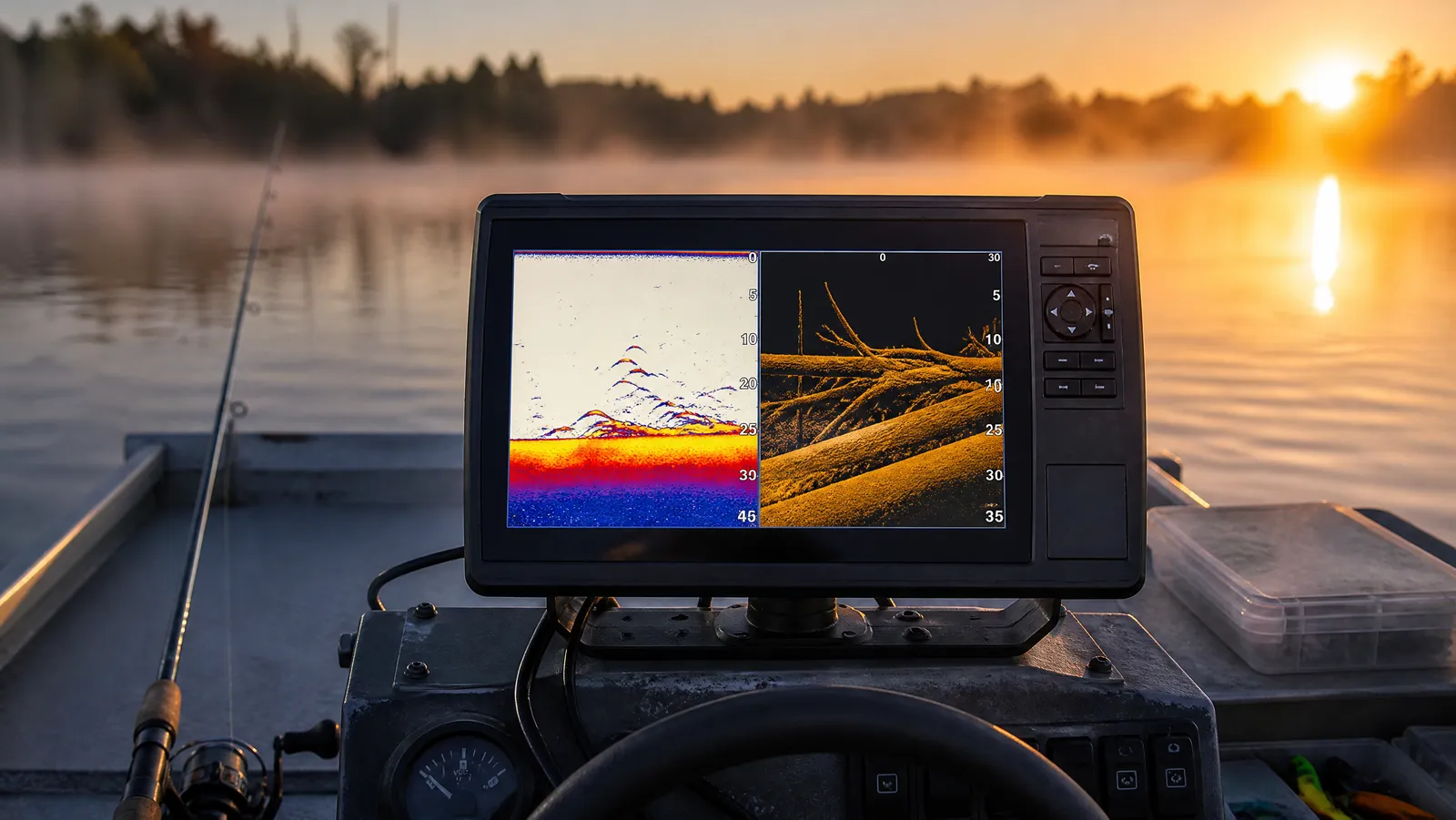
Down imaging does not draw arches. Humminbird describes its Down Imaging as a razor-thin, high-frequency beam that produces picture-like images of structure and vegetation. A fish crosses that narrow beam too quickly to trace an arch, so targets appear as bright dots, dashes, and blobs instead. That is not a malfunction.
Learning how to read a fish finder is mostly a matter of correlating what you see with what you already know: idle over a dock you can see, a channel you have marked, and a brush pile you planted, and let your brain build the translation table. Turn Fish ID symbols off while you do it — cartoon fish icons hide the raw returns you are trying to learn.
Kayaks, Canoes, and Small Craft
A kayak changes the math. Every ounce matters, there is no console to cut a hole in, and the electronics have to survive spray, sun, and the occasional capsize.
Screen size is a constraint, not a preference. A 5-inch unit on a kayak gunwale is already a large object. Most paddlers land on 3.5-inch to 5-inch displays not because bigger is worse but because bigger is genuinely in the way. The Garmin Striker 4 and its 1.9 by 2.9 inch display is a common choice for exactly this reason, and its IPX7 rating means it tolerates the splash environment.
Transducer mounting is the real project. Kayak anglers generally choose one of three approaches:
- Scupper-hole mounts drop the transducer through an existing hole in a sit-on-top hull. Clean, but you lose a scupper and gain a snag point in shallow rock.
- In-hull shoot-through installs glue the transducer inside the hull. Nothing hangs below the boat and nothing snags, but you lose some sensitivity and cannot use imaging that requires direct water contact on many hulls.
- Arm or track mounts hang the transducer over the side on an adjustable arm. Easiest to remove, most vulnerable to rocks and docks.
Power should be small and sealed. A modern unit draws very little — the Striker 4 is rated at 0.23 amps at 12 volts — so a small sealed battery in a dry bag runs a full day. We cover the arithmetic further down.
Ask ten paddlers what the best fish finder for kayak fishing is and you will get ten answers, because the honest answer depends on how permanent you want the install. If you own one kayak and fish it every weekend, a hard-mounted unit with a real transducer is worth the afternoon of drilling. If you rent, borrow, or switch between a canoe and a friend's jon boat, a castable sensor that stows in a tackle tray makes far more sense.
One habit worth building either way: mark waypoints obsessively. A small boat covers water slowly, and a saved map of stumps, rock transitions, and grass edges turns each trip into an accumulating asset rather than a fresh search.
Forward-Facing Sonar and the 2026 Rule Changes
Live scanning sonar shows targets in real time in front of the boat rather than as a scrolling history beneath it. It is the most consequential fishing technology of the last decade, and 2026 is the year the sport started pushing back on it.
What B.A.S.S. did. On September 2, 2025, B.A.S.S. announced that for the 2026 Elite Series, live sonar would be permitted in only five of the nine regular-season events, with the qualifying events determined randomly by coin flips pairing events on the schedule. The flips landed on Lake Martin, the Arkansas River, Lake Murray, the Pasquotank River/Albemarle Sound, and the St. Lawrence River; at the other four — Lake Guntersville, the Tennessee-Tombigbee Waterway, the Santee Cooper lakes, and Lake Champlain — it is prohibited entirely, including during official practice. The 2025 restrictions carry over: one live sonar transducer per boat and a maximum of 55 total screen inches. The 2026 Bassmaster Classic still allows the technology, because its qualifiers earned their spots under the 2025 rules. B.A.S.S. CEO Chase Anderson said "no single technology should define bass fishing," while former Bassmaster Classic champion Davy Hite said the rule "ensures our next Angler of the Year will be the most versatile angler on the planet."
What Major League Fishing did. MLF announced restrictions across every level it runs, from the Phoenix Bass Fishing League up to the Bass Pro Tour. On the Bass Pro Tour, anglers may use forward-facing sonar or 360-degree sonar during only one of three competition periods per day, and must declare in advance which period they intend to use. Other circuits, including the Toyota Series and Phoenix Bass Fishing League, get one continuous three-hour segment per competition day. MLF says the rules are enforced with electronic lock boxes that log how long units are unlocked, plus live-streaming security cameras onboard each pro's boat. Heavy Hitters and Fishing Clash Team Series events are exempt, because anglers there compete in identical league-issued boats.
What it means for the rest of us. Nothing legally — these are tournament rules, not regulations, and your local lake rules are set by your state agency. But the signal is worth reading. Two major organizations decided the technology needed limits — B.A.S.S. framed its rule around keeping competition diverse and rewarding versatility — and both now push anglers back onto mapping, structure, and traditional sonar for part or all of each event.
The hardware, if you are curious. Garmin says its LiveScope XR system reaches 500 feet down and forward in fresh water and 350 feet in salt water, using an LVS62 transducer operating between 265 and 550 kHz, with a published target separation of 22 inches at 100 feet. Systems like this are the most expensive electronics most anglers will ever consider, and they typically require a dedicated black box, a trolling-motor mount, and a compatible display. For most weekend anglers, that money buys more fish as a better transducer, a better battery, and a mapping-capable head unit.
Sonar Views: CHIRP, Down Imaging, and Side Imaging
Three views do almost all the work on a modern unit. They answer different questions, and knowing which question you are asking is most of the battle.
CHIRP (traditional 2D sonar). According to West Marine, CHIRP stands for Compressed High-Intensity Radiated Pulse, and instead of firing one frequency it sweeps a range of frequencies using pulse compression. West Marine notes that CHIRP transmits pulses roughly ten times longer in duration than traditional sonar, putting ten to fifty times more energy into the water column even though peak power is often lower. The practical result is better target separation — two fish two feet apart show as two marks instead of one blob.
The Humminbird Helix 5 G3 is a good illustration of how manufacturers use that flexibility. Its Dual Spectrum CHIRP offers a Wide Mode for maximum coverage when you are searching and a Narrow Mode for detailed scanning when you have found something, with a Low-Q transducer built for 2D target separation. At about $306 as of August 2026 it also brings Basemap coverage of more than 10,000 lakes. If you want one unit that handles searching, mapping, and vertical fishing without a second purchase, the Humminbird Helix 5 G3 is where we would start.
Down imaging. A thin, high-frequency beam aimed straight down that renders structure photographically. Standing timber looks like timber. Brush piles look like brush piles. It is the best view for identifying what a 2D return actually is, and for watching a bait relative to cover directly beneath you.
Side imaging. The same picture-like rendering, thrown out to both sides of the boat. Humminbird says its Side Imaging beam scans up to 400 feet to the left and right of the boat, for total coverage of up to 800 feet, which means a single pass covers dramatically more water than a down-looking view.
The side imaging vs down imaging question is really a question about what stage of the day you are in. Side imaging is a search tool — idle a shoreline, find the isolated laydown or the rock pile nobody else has, and drop a waypoint. Down imaging is a confirmation tool — go back to that waypoint, sit on it, and figure out whether anything is home. Anglers who own both tend to use side imaging for the first hour and 2D CHIRP for the rest of the day.
Note that on the Helix line, side imaging requires stepping up to a different model. That is a normal industry pattern: 2D CHIRP and down imaging come standard well down the price ladder, side imaging sits a tier above.
Fishing From Shore and Without a Boat
Sonar used to require a hull, a battery box, and a transducer bolted to a transom. That has not been true for several years, and bank anglers have more options than they realize.
That is where portable fish finders come in. The category splits into two designs:
- Castable sonar balls that tie to your line, float where they land, and stream sonar back to a phone.
- Portable kits that pair a standard head unit with a suction-cup or clamp transducer and a small battery in a carry bag.
The Garmin Striker Cast represents the first design well. It pairs with a free app on Apple or Android devices and streams sonar wirelessly from up to 200 feet away, offers both traditional 2-D and ice fishing flasher modes, and runs more than 10 hours on an internal USB-rechargeable battery. It powers on automatically when it floats in water and off when you take it out, which eliminates the classic dead-battery-in-the-tackle-bag problem. It can also download Quickdraw Community maps with contours as tight as one foot.
Two honest limitations. This version has no built-in GPS — a separate GPS model exists — and there is no standalone screen, so your phone is the display and your phone's battery is now part of the system. Casting a sensor and reeling it back is also slower than idling with a hull-mounted transducer.
For bank fishing, that trade is usually worth it. A single cast off a point tells you where the drop-off starts, how deep the flat runs, and whether bait is stacked in the channel — information that used to require a boat. At about $130 as of August 2026, the Garmin Striker Cast costs about the same as an entry-level head unit while going places a head unit cannot.
Practical tips: fish it on a spare rod with braid so you can feel the retrieve, cast it upcurrent and let it drift over the zone you care about, and keep your phone in a waterproof case with the screen brightness up. In bright sun, a phone screen is harder to read than a dedicated marine display, which is the main reason serious boat anglers still buy standalone units.
Transducers: The Part That Actually Matters
If you have a fixed budget and you are agonizing over screen size, stop. The display shows you what the sensor collects, and no processor recovers information the sensor never gathered.
Frequency controls the trade-off between detail and coverage. West Marine's transducer guide explains it cleanly: 200 kHz and other high frequencies display the higher-resolution image, 83 kHz gives the widest coverage area, and frequencies below 80 kHz are what you reach for in water deeper than about 600 feet. Lower frequencies send and receive over a wider cone, so they cover more water, detect fish that are not directly beneath the boat, and penetrate deeper — but they show less target separation. Higher frequencies use a narrow beam and show more detail.
Practically: search with the wider, lower frequency, then switch to the higher frequency when you want to see individual fish and your bait.
Mounting style is chosen by hull, not by preference. The three standard options are:
- Transom mount. An adjustable bracket bolts to the transom with the transducer hanging below and behind the hull. Simplest to install, and the default for aluminum boats, jon boats, and most small craft. Its weakness is turbulent water at speed.
- Thru-hull. The transducer passes through the hull for the cleanest possible water flow. Standard on larger boats and displacement hulls, and the only choice for serious deep-water work.
- In-hull (shoot-through). Mounted inside the hull against a fluid-filled housing or high-density pad, with no drilling. Useful for cored hulls and rental or shared boats, at the cost of some sensitivity.
Two installation details cause most of the complaints we see about fish finder transducers. First, height: mounted too high, the transducer ventilates and loses bottom at speed; mounted too low, it drags and throws spray. Aim for the face sitting just below the hull bottom, parallel to the water. Second, location: keep it out of the prop wash and away from strakes, rivets, and anything that puts bubbles under the face. Air is the enemy of sound.
Finally, match the transducer to the sonar you actually want. Down and side imaging require imaging-capable transducers. A CHIRP head unit paired with a single-frequency transducer gives you a CHIRP menu and traditional performance.
Ice Fishing Electronics and Flashers
Ice fishing inverts the problem. You are not searching a lake at 3 mph; you are sitting over an eight-inch hole trying to watch a lure and a fish converge in real time.
That is why the flasher survived the LCD era. A flasher displays a single moment in time — what is under the transducer right now — on a circular dial, rather than scrolling a history across a screen. When a walleye rises six inches to your jig, a flasher shows it happening instantly. It is the most direct feedback loop in fishing.
Modern ice fishing fish finders now split into three approaches:
- Dedicated flashers from makers like Vexilar and MarCum, built for cold, bright conditions and long battery life.
- Hybrid units that combine a flasher dial with an LCD readout for depth, temperature, and settings.
- Open-water units run in flasher mode, which is how most anglers get onto the ice cheaply.
Two specifics worth knowing. MarCum lists the LX-7L with a dual-beam 8/20-degree ice transducer, so you can choose an 8-degree narrow or 20-degree wide cone, which matters when you want to exclude the walls of a shallow hole or watch a wider zone in deep water. And on battery life, Fishing Duo's flasher comparison puts LCD fish finder runtime on the ice at roughly 4 to 12 hours per charge, versus 18 hours or more for most flashers, because bright LCD screens draw far more power than a simple dial.
If you already own an open-water unit, check whether it has a flasher mode before buying anything. The Garmin Striker 4 includes a built-in flasher mode that shows sonar in the classic circular format, which makes it a genuine two-season purchase. The Garmin Striker Cast also includes an ice fishing flasher mode, and because the sensor simply floats in the hole and streams to your phone, it is one of the least complicated ways to try sonar on ice.
Cold-weather cautions: lithium batteries lose usable capacity in deep cold and should be kept inside a jacket or an insulated bag between holes, transducer cables get stiff and crack if you coil them tight at 10 degrees, and any screen not rated for freezing temperatures can go sluggish. Bring the unit inside overnight rather than leaving it in the truck.
Powering Your Electronics
Power is where good electronics setups quietly fail. The unit browns out mid-day, the screen flickers over rough water, and the angler blames the sonar.
Start with the actual draw. Modern small units sip power. The Garmin Striker 4 is rated at 0.23 amps at 12 volts. Battery guides calculate runtime as amp-hours divided by amps, so a 7 Ah battery driving a 0.23 amp load pencils out to roughly 30 hours on paper. Real capacity is always lower — cold, age, and voltage sag all take a cut — but the point stands: a small battery runs a small unit all day with room to spare. Bigger screens and imaging draw considerably more, so check your specific model's rating rather than assuming.
Lead-acid versus lithium. Sealed lead-acid batteries are cheap and widely available, and a 12V 7Ah brick weighs about five pounds — spec sheets typically list 4.8 to 5.2. Battery manufacturers including MANLY and Ufine put LiFePO4 lithium cycle life in the 3,000 to 5,000 range versus roughly 300 to 500 for sealed lead-acid, at 50 to 75 percent less weight for the same usable capacity, with steadier voltage under load. On a kayak, where every pound is on your back at the launch, that weight difference is the argument. In a boat with a console, lead-acid still makes economic sense.
Good news for anyone shopping: fish finder batteries have gotten dramatically smaller and lighter, and a sealed lithium pack sized for a small unit now fits in a dry bag alongside your lunch.
Wiring habits that prevent problems:
- Run the unit on its own fused circuit, direct from the battery when possible, not spliced off an accessory line shared with a bilge pump or aerator.
- Use the fuse the manufacturer specifies, at the length of wire they specify — undersized wire causes voltage drop that looks like a failing unit.
- Keep power and transducer cables separated where you can. Running them together invites electrical interference that shows on screen as horizontal noise bands.
- Charge before every trip rather than after every third one, and keep a spare battery if you are running a phone-dependent setup like a castable sensor.
If your screen shows noise only when the trolling motor or engine runs, you have an interference problem, not a sonar problem. Separating the cables and cleaning up the ground connection solves most of them.
Where to Start
If you are buying your first unit, the order that works is simple: pick the smallest head unit whose screen you can genuinely read, spend the savings on the right transducer and a decent battery, then spend a season learning to correlate what is on the screen with what you can see and feel.
For a boat, we would start with a CHIRP-and-GPS unit in the Striker 4 range and step up to something like the Helix 5 G3 when mapping and screen size start limiting you. For a kayak, decide first whether the install is permanent. For the bank, a castable sensor removes the barrier entirely.
And take the 2026 tournament rule changes as encouragement rather than trivia. When the two biggest organizations in bass fishing decide that structure reading and traditional sonar deserve to decide events again, the affordable unit on your gunwale is closer to the cutting edge than it has been in years.
Explore the full series
- Best Fish Finder for the Money: Real Sonar Without the Tournament Budget — What real sonar costs, and which units are worth it under $500.
- How to Read a Fish Finder: Arches, Bait Balls, and Bottom Hardness — Arches, bait balls, bottom hardness, and what to ignore on the screen.
- Best Fish Finders for Kayaks: Compact Units That Actually Fit — Compact units, current draw, and the mounts that make them work on a paddle craft.
- Forward-Facing Sonar Explained: What It Does, What It Costs, and the 2026 Rule Changes — How live sonar works, what a full rig costs, and the 2026 tournament rule changes.
- Side Imaging vs Down Imaging: Which Sonar View You Actually Need — Which sonar view finds structure, which one shows detail, and which to buy first.
- Portable and Castable Fish Finders: Sonar From the Bank — Castable and two-piece sonar for anglers fishing from the bank, a dock, or the ice.
- Fish Finder Transducers Explained: CHIRP, Frequencies, and Mounting — Frequencies, cone angles, CHIRP, and the mounting mistakes that ruin a good unit.
- Ice Fishing Fish Finders and Flashers: Reading the Hole — Flashers versus graphs, reading the dial, and what the cold does to your electronics.
- Fish Finder Batteries: Sizing, Lithium vs Lead, and Real Runtime — Sizing a 12V pack from your unit's real current draw, and where lithium earns its price.
The Picks, Tested
Garmin Striker 4
A 3.5-inch keyed-interface CHIRP fishfinder with a dual-beam 77/200 kHz transducer and high-sensitivity GPS for marking waypoints.
- Dual-beam CHIRP sonar and GPS waypointing at the lowest price in the Striker line
- Built-in flasher mode works for ice fishing and vertical jigging
- Waypoint map marks brush piles, stumps and docks; IPX7 water rating
- 3.5-inch screen is small for split-screen sonar views
- No preloaded lake maps, only Quickdraw Contours you record yourself
- Keyed buttons rather than a touchscreen

Humminbird Helix 5 G3
A 5-inch chartplotter/fishfinder running Dual Spectrum CHIRP sonar with a Wide Mode for maximum coverage and a Narrow Mode for detailed scanning, using a Low-Q transducer for 2D target separation. It ships with Humminbird Basemap covering more than 10,000 lakes plus continental U.
- Dual Spectrum CHIRP offers both Wide and Narrow search modes
- Basemap covers 10,000+ lakes; accepts LakeMaster, CoastMaster and Navionics
- AutoChart Live maps contours and bottom hardness with 8 hours of recording
- Costs roughly twice a Striker 4
- Softkey keypad control rather than a touchscreen
- Side imaging requires stepping up to a different Helix model

Garmin Striker Cast
A castable sonar ball that pairs with the free Striker Cast app on Apple or Android devices and streams sonar wirelessly from up to 200 feet away. It offers traditional 2-D and ice fishing flasher sonar modes, works in both shallow and deep water, and runs 10+ hours on an internal USB-rechargeable battery.
- Streams sonar up to 200 feet away — works from bank, dock or kayak
- 10+ hours on the internal USB-rechargeable battery
- Auto power-on in water; 2-D and ice flasher modes included
- Requires a smartphone or tablet — there is no standalone screen
- This version has no built-in GPS (a separate GPS model exists)
- Casting the sensor repeatedly is slower than a hull-mounted transducer
Compare The Field
| Compare | Best Starter Unit Garmin Striker 4 | Best All-Around Humminbird Helix 5 G3 | Best for Bank and Kayak Garmin Striker Cast |
|---|---|---|---|
| Overall | — | — | — |
| Price | $130.99 Check price → | $306 Check price → | $129.99 Check price → |
About The Author
Rob Thomas
Rob Thomas is a fisherman who loves catching tales from his fellow fishermen. He always enjoys a good story, especially when it comes from the sea.